
 5 months ago
45
5 months ago
45

By Cherith Glover Fluker | For the Birmingham Times
Over the past year, I’ve fallen in love with Birmingham all over again. The city itself has remained largely the same, but I have changed. While researching for my book, “Secret Birmingham: A Guide to the Weird, Wonderful, and Obscure,” I began looking at familiar places as if I were seeing them for the first time. I also began searching for places I had somehow overlooked. I slowed down, asked more questions, and wandered a little more than usual.
And somewhere along the way, I became a tourist in a city I thought I already knew.
As vacation season approaches, many families will begin weighing budgets and destinations, searching for the right place to get away. There will be conversations about flights, hotel stays, and how far the budget can stretch this year. But before booking that flight or packing the car, it’s worth considering something closer to home. Some of the most meaningful experiences may already exist just a few miles away.
It took a trip to Washington, D.C., to make that clear to me.
Standing inside the Smithsonian American Art Museum, I came across “The Dreamer,” a work by Joe Minter, a Birmingham artist who has spent decades building something remarkable in his own yard. The piece made me stop and take a closer look. The attached museum placard described Minter’s creation, “African Village in America,” as a deeply moving tribute to African American history, struggle, and survival. The most surprising revelation at that moment was learning its location: Birmingham’s Titusville community. Seeing a Black artist from Birmingham being celebrated in one of the most prestigious museums in the country gave me chills.
There was something jarring about encountering his work hundreds of miles away, framed and contextualized for an audience that may never set foot in Birmingham, while I — someone who had lived in Alabama my entire life — had somehow missed it entirely.
That realization stayed with me long after I left the museum.
Familiarity has a way of dulling our vision. We assume we already know what our city has to offer, and in doing so, we overlook what has been there all along. Birmingham holds more history, culture, and creativity than many of its own residents have ever fully explored. The streets of this city hold so much of that history. Seeing it clearly again begins with one thing: deciding to look.
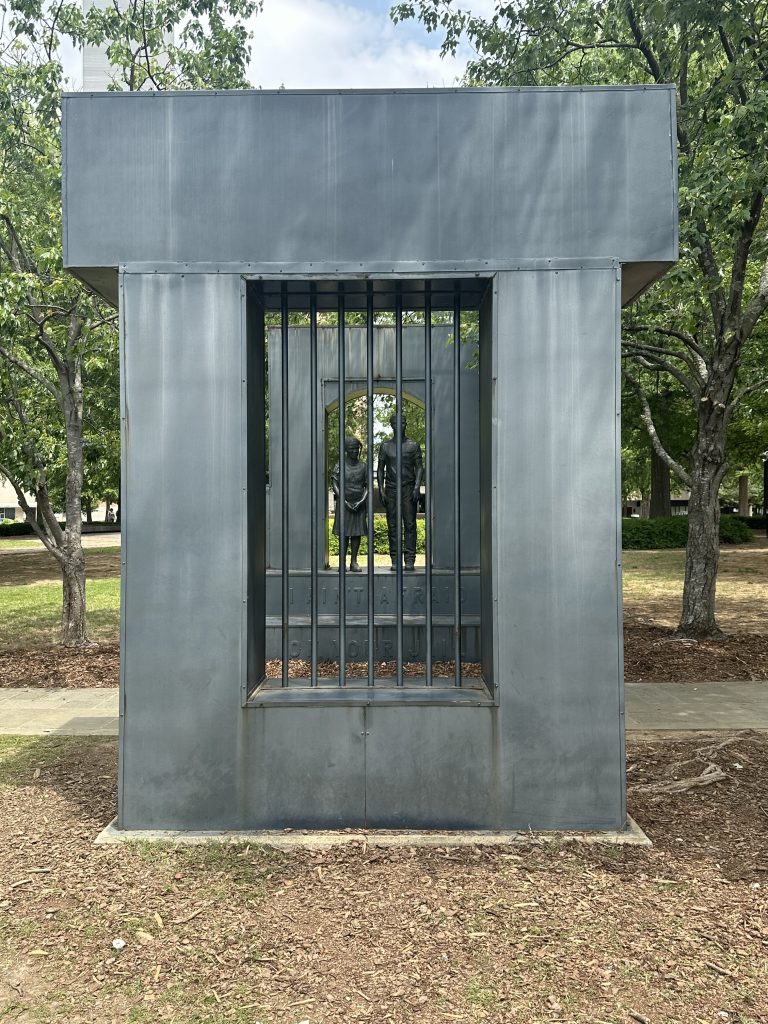 Birmingham’s Civil Rights history can be found throughout the city. (Courtesy Of Cherith Glover Fluker)
History Hiding in Plain Sight
I visited the Birmingham Civil Rights Institute during Black History Month this year. It had been a while since my last visit, so I wanted to go again. Partly out of intention, and partly because I had been thinking about how often we let the most important places become mere scenery.
I’m glad I went.
Though the exhibits themselves remain as powerful as ever, I was struck by the young people visiting the institute that day. There were several youth groups moving through the galleries that morning, and I found myself stopping to watch them. I watched as curious students leaned in toward the displays, asking their teachers and the docents questions, possibly even leaving with more questions than they’d arrived with. Adults crouching down to meet them at eye level, having real conversations about things that happened in this city, on these streets, not so long ago. That passing of history from one generation to the next in real time is something a textbook simply cannot replicate.
Every time I visit the Civil Rights Institute, I have a different experience. That’s what makes it worth returning to. I suggest going on a weekday morning if you can. Give yourself more time than you think you need. And go with someone you can talk to afterward.
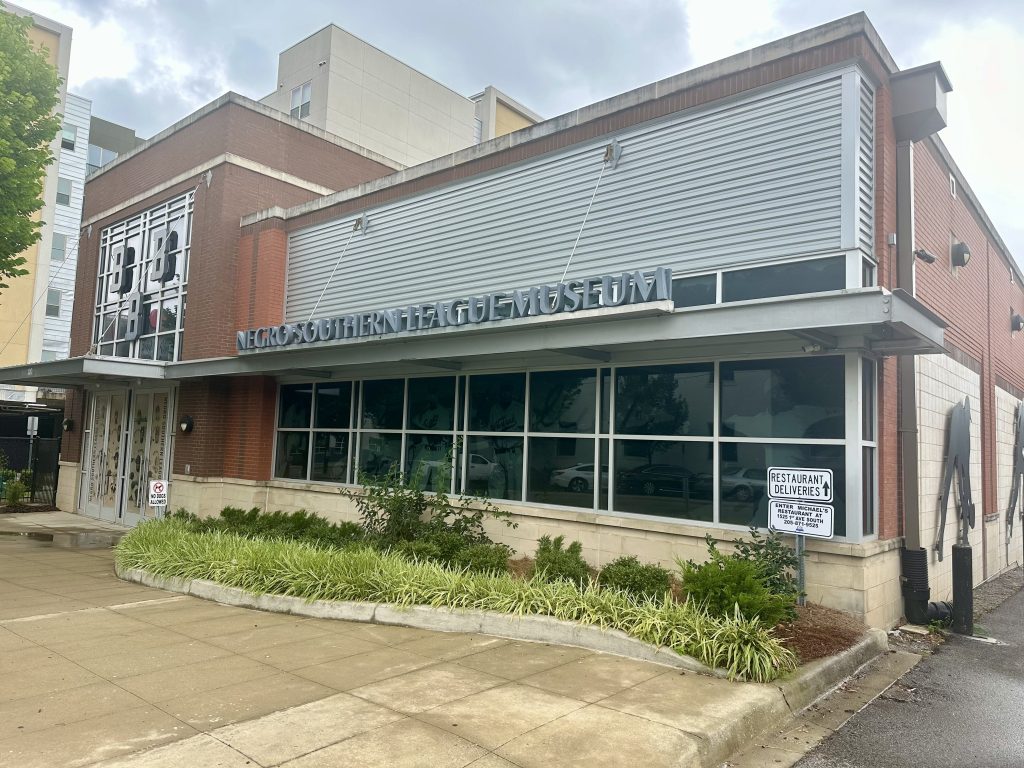 The Negro Southern League Museum tells another essential part of Birmingham’s story. (Courtesy Of Cherith Glover Fluker)
Just a few blocks away, the Negro Southern League Museum tells another essential part of Birmingham’s story. I’ll be honest, I had driven past it more times than I can count before I actually went inside while doing research for my book. It’s a small museum, but it leaves a mark. The entryway alone grabs your attention and makes it immediately clear just how deep the Black contribution to baseball runs and how central Birmingham was to that legacy. The museum honors the players’ talent, resilience, and the joy they brought to communities at a time when they needed it. These were men who were every bit as talented as their white counterparts and never got the recognition they deserved. This museum makes sure they are not forgotten. Walk through it, and you’ll leave with a newfound pride in the city.
Nearby, the Alabama Jazz Hall of Fame, housed in the historic Carver Theatre, offers yet another layer of the city’s history. I went in thinking I knew something about Birmingham’s contributions to jazz. I was wrong. The exhibits are rich, the stories are remarkable, and if you opt for a guided tour, you’ll find yourself in a conversation that goes far beyond what’s on the walls. Birmingham produced Sun Ra, Erskine Hawkins, and musicians who went on to perform alongside Duke Ellington. On certain evenings, the Carver Theatre still hosts live music. If you can catch a live performance there, do it. Hearing jazz in a room that hosted music for nearly a century would be an unforgettable experience.
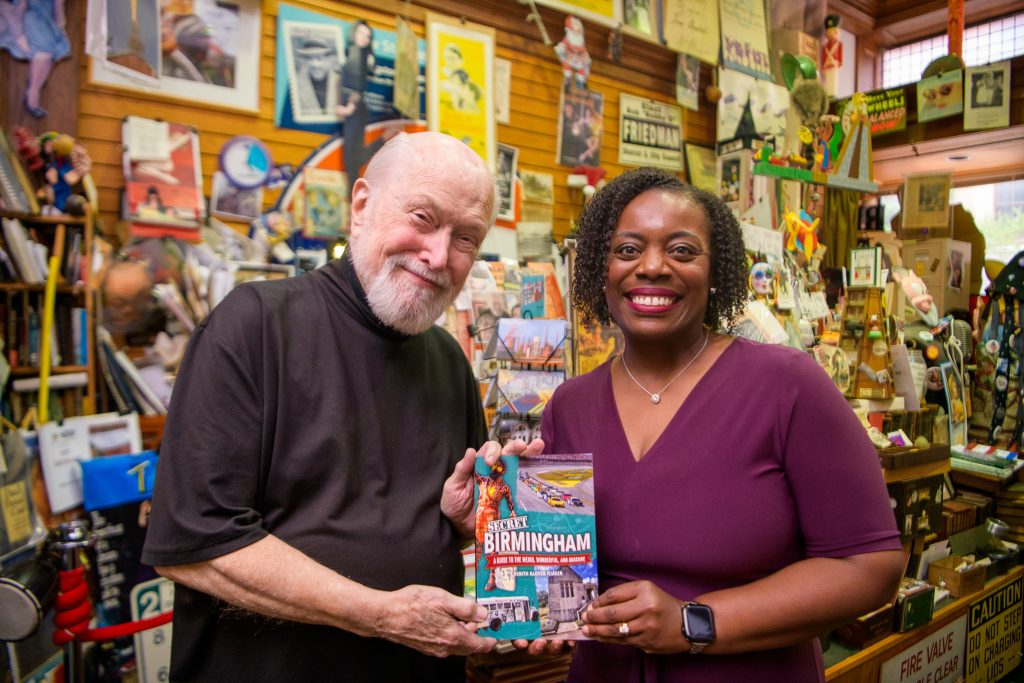 Cherith Glover Fluker, right, author of “Secret Birmingham: A Guide to the Weird, Wonderful, and Obscure,” with Jim Reed of The Museum of Fond Memories at Reed Books. (Amarr Croskey, For The Birmingham Times)
Places That Stop You in Your Tracks
One thing I’ve learned as I’ve decided to be a tourist in my own town is to stop assuming I know what a place will be like before I get there. I’ve walked into spaces expecting one thing and found the experience to be something else entirely. It’s usually something better, and something that stayed with me well past my time there. That’s exactly what happened with The Museum of Fond Memories at Reed Books.
The first time I walked in, I’ll be honest: I didn’t know where to begin. So many things were competing for my attention. Objects from nearly every decade of the last century fill the shelves, the cases, the walls, and any remaining surfaces. Vintage lunch boxes, old board games, antique toys, and signs and packaging from discontinued food and candy brands are all throughout the store. You’ll find things you forgot existed until you see them, and then suddenly you’re recalling all sorts of memories from your childhood. My first instinct was to step back. My second was to slow down and change my perspective entirely.
Once I did that, the place opened up.
What I found, piece by piece, was something I wasn’t expecting: my own memories. Walking through the aisles unlocks something in you. The more objects I saw, the more memories were unlocked. I talked to Jim Reed, the owner, about how the museum came to be and how it has grown over the years. That conversation alone was worth the trip. He has been collecting, curating, and sharing these pieces for decades, and his love for the work is evident in every corner of the space.
And then there are the books. Nearly 300,000 of them, with some titles dating back centuries. You can easily lose track of time browsing the shelves. Just when you think you’ve seen it all, something else surprises you. And don’t worry if you’re looking for something specific and having trouble finding it. Reed can likely point you right to it.
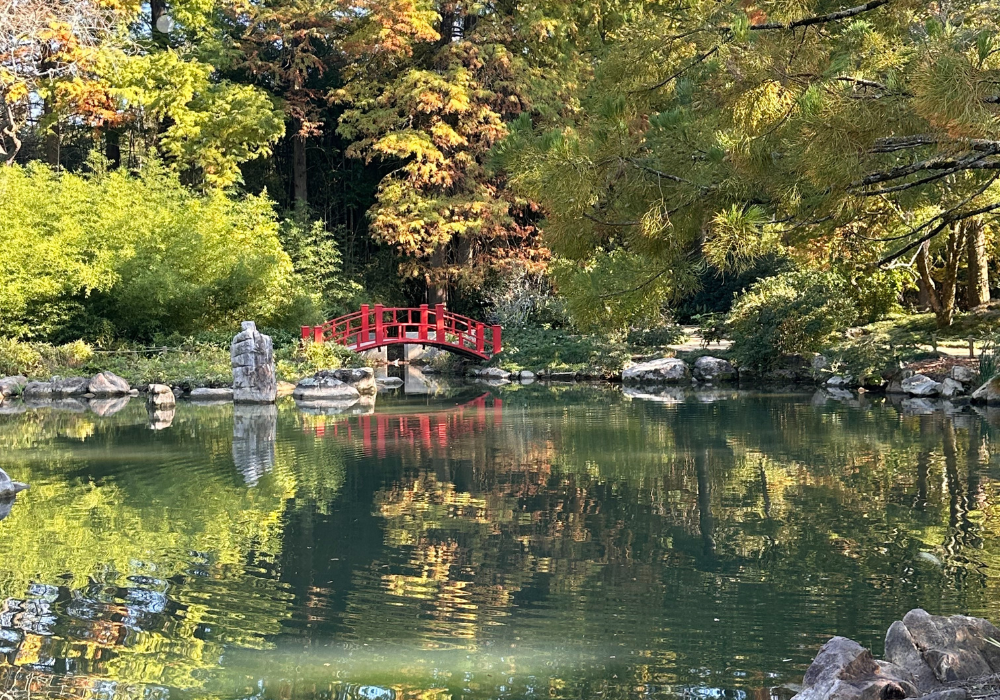 Make sure to explore the Japanese Garden at the Birmingham Botanical Gardens. (Courtesy Of Cherith Glover Fluker)
From there, make your way to the Birmingham Botanical Gardens and make sure to explore the Japanese Garden. I’ll admit the garden meant more to me once I learned its history.
The Japanese Garden dates back to 1965, when the Federated Garden Club of Alabama started raising money for it. They brought in a Japanese-American architect, Masaji “Buffy” Murai, to design it, and it was such a big deal that the Japanese ambassador came to Birmingham for the opening in 1967! In 1985, Birmingham’s sister city, Hitachi, Japan, gifted the garden with a stone lantern to mark the 60th year of Emperor Showa’s reign.
The story behind it added a layer that changed how I walked through it. The bamboo garden draws you in gradually, and somewhere between the stone lanterns and the koi pond, you almost forget that you’re just outside a bustling city. It takes a little effort to find, but the stillness waiting at the end of that walk is worth every step.
A short drive away, Vulcan Park and Museum offers a perspective that changed everything for me. In October, I visited the observation tower at night for the first time. It was an entirely different experience. Standing up there after dark, with Birmingham spread out below, was one of the best views of this city I have ever seen. The sparkle of the lights over the city showed me a side of Birmingham I had never seen before.
Unexpected Attractions
Part of being a tourist in your own town is being willing to be astonished. This means being open to the unexpected.
The Barber Vintage Motorsports Museum does that.
I walked in knowing it held a large motorcycle collection. I’m not sure I understood what large actually meant. The museum is home to more than 1,600 motorcycles and racing cars, holds the Guinness World Record for the largest motorcycle collection, and draws visitors from more than 16 countries.
Bikes are suspended from ceilings, mounted across five floors, and arranged in sweeping displays that feel more like sculpture than exhibition. I was surprised not only by the scale of the museum but also by the stories attached to individual machines. Some of these vehicles are genuinely one-of-a-kind. The museum includes the 1964 Ferrari F-158 in which John Surtees won the Formula 1 World Championship. This iconic piece of motorsports history is sitting right here in Birmingham. People travel from across the world for this experience.
Not far away, the Southern Museum of Flight tells a side of Birmingham’s story that most residents have never considered exploring. Through aircraft, artifacts, and interactive exhibits, it preserves the city’s aviation history. There is more here than most visitors expect.
Then, when you are ready to trade indoor exploration for the great outdoors, head out to Turkey Creek Nature Preserve in Pinson.
I knew Turkey Creek was a beautiful place to spend an afternoon, but I didn’t know it was one of the most ecologically significant sites in Alabama. The preserve is home to five endangered fish species, including the Vermilion Darter, found only in Turkey Creek and nowhere else on Earth. The Rush Darter is similarly found only here. This nature preserve can hold its own against some of the most celebrated natural destinations in the country.
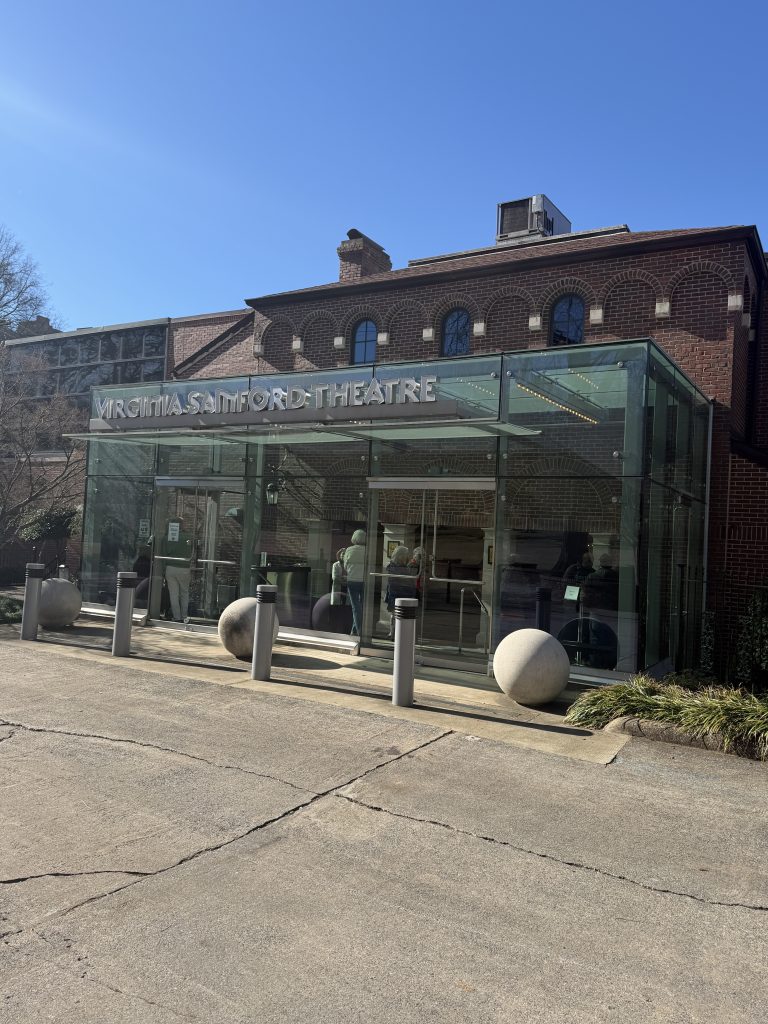 Virginia Samford Theatre is the oldest performing arts venue in Birmingham. (Courtesy Of Cherith Glover Fluker)
Art in the City
Being a tourist in your own town also means showing up for the artists and creators. It means buying a ticket. Filling a seat. Letting the artists and performers who chose Birmingham know that what they make matters.
Virginia Samford Theatre has been doing its part for a very long time.
Founded in 1927, it is the oldest performing arts venue in Birmingham. The theater seats just over 300 people, so there is no bad seat in the house. You are not watching a performance from a distance; you are inside it. Productions of “Little Women,” “Assassins,” and “Who’s Afraid of Virginia Woolf” have all graced the stages at the Virginia Samford Theatre. That range reflects the theater’s commitment to bringing challenging, relevant, and well-respected work to Birmingham audiences.
Beyond theatrical productions, Virginia Samford is also a gathering place for other community events and performances. Most recently, I attended a screening of “Tuxedo Junction,” a documentary that tells the story of how jazz was cultivated and popularized in Birmingham’s Ensley neighborhood in the 1920s through the 1950s.
Check the schedule before you go. I’ve found that there is almost always something on the calendar worth seeing. In an age of streaming and screens, it is nice to be in a room where something live is happening right in front of you.
The Birmingham Museum of Art offers another reason to show up for the arts. Free and open to the public, it houses one of the largest art collections in the Southeast. The collection includes more than 27,000 works spanning thousands of years and dozens of cultures. With rotating exhibitions and special events throughout the year, there is always a reason to come back. You won’t have the same experience twice.
Birmingham has a consistent history of fostering the arts. Our theatres and art institutions are proof of that, and they deserve an audience that shows up for them.
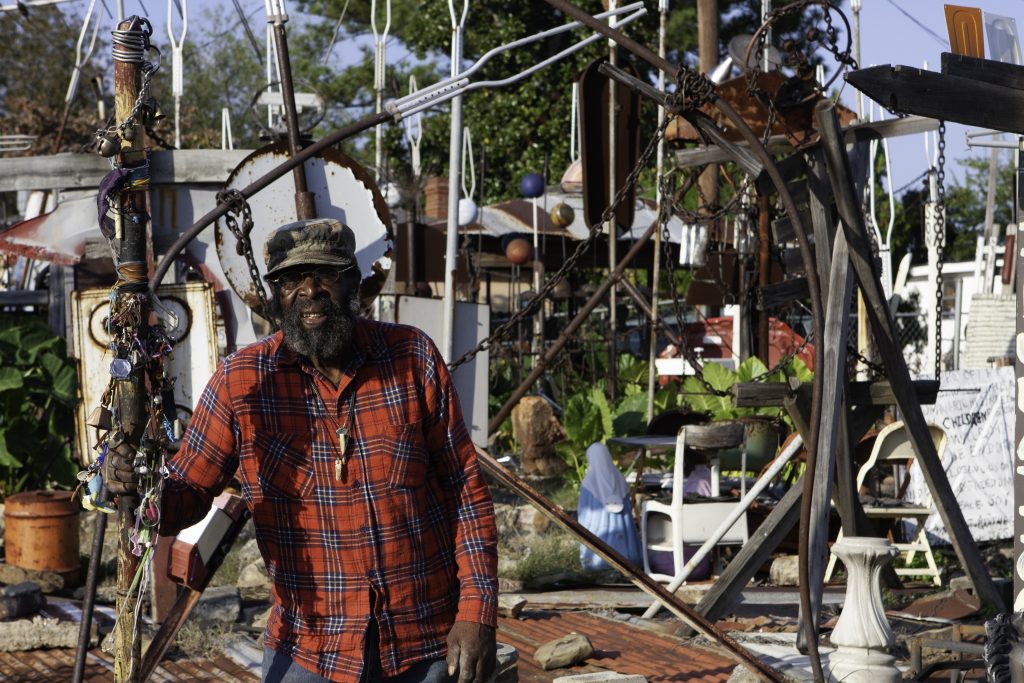 Joe Minter’s “African Village in America occupies the yard of Minter’s home in Birmingham’s Titusville community. (Courtesy Of Kelly Ludwig)
Be a Tourist at Home
After returning from Washington, D.C., I made a decision. I was going to stop overlooking what had always been within reach.
My first mission: find Joe Minter’s “African Village in America.”
The site occupies the yard of Minter’s home in Birmingham’s Titusville community. Minter began building it in 1989, inspired in part by the city’s plans to construct a civil rights museum. He worried the foot soldiers — the everyday people who marched, organized, and sacrificed — would be left out of the official narrative. So, he built his own memorial. Piece by piece, year by year, using salvaged materials: metal, wood, stone, and found objects. More than 100 hand-crafted sculptures and installations now fill the space.
Standing there, I thought about all the things I had driven past without stopping. All the museums I had meant to visit. The trails I hadn’t explored and the performances I had missed. I thought about all the places I had told myself I would get to eventually.
Eventually has a way of never coming if you’re not intentional about making it happen.
Birmingham is a place of remarkable depth. It is defined by resilience, creativity, and a history that continues to unfold on every block. The people and places that carry those stories deserve to be experienced. Not someday, but now.
So, before you finalize those vacation plans, I want to challenge you to be a tourist in your own town. Go back to the Civil Rights Institute and watch the next generation ask the questions you forgot to ask. Go see a show at the Virginia Samford Theatre. Walk into Reed Books without a plan and see what finds you. Drive out to Turkey Creek and let the afternoon slow down the way afternoons used to. Stand on top of Red Mountain after dark and look out over everything this city has built, survived, and become.
You don’t have to go far to find something extraordinary. You just have to decide to look.
Follow Cherith Glover Fluker’s adventures in Birmingham and beyond at whatcherithinks.com.