
 4 months ago
38
4 months ago
38
By Javacia Harris Bowser | The Birmingham Times
The Birmingham City Council approved a comprehensive zoning ordinance on Tuesday to establish 20 protective conditions for hyperscale data centers. The guidelines will apply to any future data center projects or expansions. While city leaders say the ordinance positions Birmingham as a national leader in responsible data center regulation, many in attendance at Tuesday’s meeting said the guardrails aren’t strong enough.
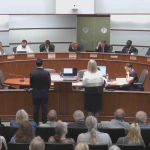
The council voted 6-3 to pass the ordinance after a nearly 5-hour meeting that included a nearly 3-hour public hearing. Residents and other stakeholders filled council chambers and overflow rooms after standing outside city hall for hours on a hot and humid day for a chance to voice their opinions. The ordinance’s approval was met with boos from a handful of attendees, some of whom then left the council chambers.
In a presentation before the public hearing, Hunter Garrison, Deputy Director of the city’s Office of Resilience and Sustainability, said the regulations are “unmatched” in the Southeast and that the ordinance provides some of the strongest safeguards in the state. Garrison also emphasized that no single protection stands alone — each condition works in tandem to regulate environmental impacts, energy use, noise, land compatibility, and community notification.
The new regulations outline 20 conditions for hyperscale data centers, which have drawn the most controversy due to their potential environmental impact.
The city defines a hyperscale center as a “large data processing facility designed to support high volume computing, storage, and networking capacity, typically operated by or for a single enterprise or a limited number of affiliated entities.”
Key features of the newly approved ordinance include:
- Strict location and separation standards, including a 500-foot setback from residential or urban neighborhood districts and a 1,000-foot separation from high-capacity transit facilities.
- A 5-acre minimum lot size for eligible sites.
- Closed-loop cooling systems to reduce water consumption, ensuring usage no greater than that of a similarly sized office building.
- Comprehensive water and stormwater oversight, including identification of water sources, conservation plans, in addition to existing state monitoring.
- Prohibitions on onsite power generation using gas turbines or 24/7 diesel generators, while allowing solar or fuel cells for on-site generation and permitting battery storage under emergency-response review.
- Noise mitigation requirements, including acoustical walls and pre- and post-construction noise studies.
- Detailed site development planning, including screening, landscaping, utility connections, and setback requirements.
- Enhanced electrical demand transparency, including peak demand projections, development phases, and utility provider identification.
- The ordinance also requires mandatory written notification via certified mail to all property owners within 500 feet of any new or expanded hyperscale data center.
The city council was previously set to vote on proposed data center regulations on April 28 but instead requested that city staff revamp the guidelines.
Three amendments to the ordinance included the following:
- adding fuel cells as a permitted energy generation system for data centers
- requiring notification to all property owners within a radius of 500 feet from a new or expanding hyperscale data center
- removing the special exception requirement for hyperscale data centers if they comply with all 20 conditions.
Special exceptions under zoning policy require approval from the zoning board via public hearings. The majority of those who spoke during the public comment period on Tuesday said that removing the special exceptions requirement meant they no longer had a say in the matter. Others pushed for greater setback requirements, arguing that 500 feet is insufficient. Some wanted more specific restrictions related to noise pollution.
On March 3, the city council unanimously voted to halt for six months any applications for new or expanding data centers within city limits while guidelines and guardrails for the facilities were developed. The new regulations approved on Tuesday will take effect when the city’s six-month moratorium on data center applications lifts.
The full ordinance can be viewed at www.birminghamal.gov/news


