
 1 hour ago
2
1 hour ago
2

By Shauna Stuart | The Birmingham Times
Deanna “Dee” Reed had a lot on her mind on May 8.
That morning, the political consultant and organizer for Black Voters Matter gathered outside of the Alabama State Capitol with politicians, faith leaders, fellow activists and community members to protest the special legislative session Gov. Kay Ivey called to reassess Alabama’s congressional maps.
Before entering the Capitol, the crowd gathered outside to set the tone for the day with protest songs. One of the songs: “Woke up this morning (With my Mind Stayed on Freedom).
“That morning I literally woke up with justice and with freedom on my mind,” said Reed. “And it was by any means necessary.”
Hours later, Reed was dragged from the Alabama House Chamber gallery by security and Alabama State Troopers as she and other activists loudly protested a debate about S.B. 1, a bill that would authorize Alabama to hold a new special primary election if federal courts allowed the state to redraw voter maps.
The moment went quickly, but Reed remembers a lot — particularly the support of her peers.
“I didn’t realize that I was the only one getting carried out until I was already outside. But I will say that there were a number of people that were willing to risk arrest that day,” said Reed. “People saw me being removed, but there were so many other people that were also fighting in their own way.”
Fellow protesters chanted “Let her go!” Politicians, including Rep. Juandalynn Givan, boldly confronted Capitol security. Others went live on social media to tell the story. Reed remembers another moment that makes her emotional.
“I will never forget Representative Travis Hendricks. He comes up, and he embraces me, and he literally says, ‘I got you,’” said Reed. “It’s just a reminder that none of us are in this fight alone.”
But Reed says her strongest memory was recognizing that she and her peers were witnessing “a public crucifixion of voting rights.”
 Deanna “Dee” Reed of Black Voters Matter (left) speaks with Reps. Juandalynn Givan (center) and Travis Hendrix, after being removed from the Alabama House gallery on May 8. (Bryan Lyman, Alabama Reflector)
All Roads Lead to the South
Reed and her fellow organizers had been at the Capitol every day of the special session. They went with a plan — to catch the attention of people who weren’t following the news cycle but were active on social media.
“We thought ‘what can we do that now generates some conversation within the community?’” said Reed. “So, we came up with the idea that we were going to meet the moment, whatever that looked like.”
As video of Reed’s removal from the Capitol rippled across social media, organizers knew they had to capitalize on the momentum. And when Reed left the grounds of the Capitol that day, she joined a planning call with more than 200 organizations that were adjacent to Black Voters Matter.
They wanted to create a massive clarion call about the state of the Voting Rights Act. In April, the Supreme Court’s 6-3 ruling in Louisiana v. Callais struck down both a majority Black congressional district in Louisiana and a landmark civil rights law that increased minority representation in Congress– a move that politicians and voting rights activists say guts Section 2 of the Voting Rights Act. The decision ignited a rapid timeline as Southern states, including Alabama, clamored to call special legislative sessions to redraw voting maps.
Read more: 65 Years Later, the Freedom Riders Are Ready for Another Battle: ‘This Movement Has to be Reopened’
So when Reed and her fellow organizers decided to organize a massive rally to discuss the future of Black political representation, they wanted the meeting ground to be in Alabama.
“The South has always really served as America’s testing ground. We’ve seen it with segregation being perfected. We’ve seen it with voter suppression, different attacks on public education, and civil rights,” said Reed. “This really is this nation’s political laboratory.”
So, they got to work, making phone calls and tapping into their networks to pull together a massive campaign in eight days. The result: “All Roads Lead to the South,” a national day of action where thousands of people rallied in the cradle of the Voting Rights Movement of the 1960s as a to protest efforts to redraw redistricting maps.
That morning attendees gathered in Selma for a mass meeting at the historic Tabernacle Baptist Church, followed by a march across Edmund Pettus Bridge in Selma, where they listened to testimony from foot soldiers including Annie Pearl Avery and Sheyann Webb-Christburg, who fought the battle for voting rights more than 60 years ago. That afternoon, thousands of people gathered in front of the Alabama Capitol to hear the rallying call of activists and politicians from Alabama and around the country.
Reed, who served as the event’s emcee, called the rally a “political and spiritual revival.”
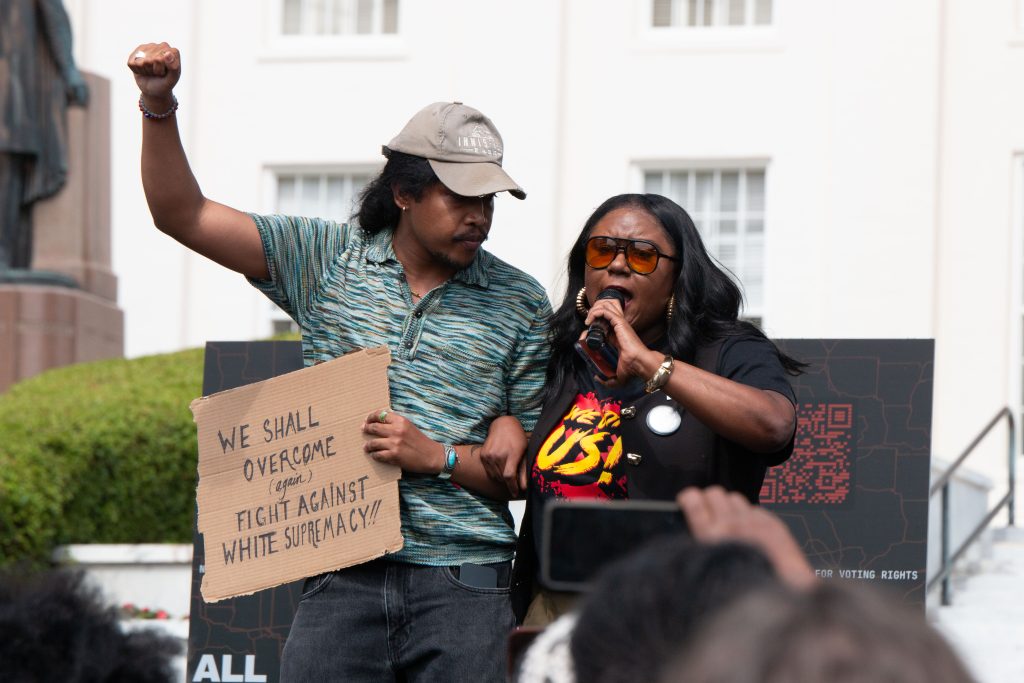 Deanna “Dee” Reed and Tennessee State Rep. Justin Jones speak at the “All Roads Lead To The South” rally in Montgomery. (Shauna Stuart, For The Birmingham Times)
Read more: ‘History Started Here’: A New Voting Rights Movement Rises in Selma and Montgomery
Reed, like many political strategists, says there isn’t a singular answer to explain the assault against Black political representation.
“This is a decade’s worth of strategy that we are seeing at play,” said Reed.
But Reed has a plan to combat redistricting. And it involves meeting people where they are.
Reed has been working on a series of intimate organization sessions around the state. In June, she was in Butler County with other organizers from Birmingham.
“We were in someone’s living room,” said Reed. “We met, and we probably had roughly 50 or so people that came together. And a lot of these folks did not have titles. They labeled themselves as concerned citizens. We had neighborhood presidents. Now, we did have some organizations that were represented, but it really has been this idea that everyone is coming to the table with something.”
Reed’s mantra — everyone can be an organizer because everyone has skills to contribute to the movement.
 Deanna “Dee” Reed and Isaiah Smith drive though Smithfield while canvasing for The People’s Project June 20. (Shauna Stuart, For The Birmingham Times)
Strategy and Purpose
Reed keeps a brick in her home office. The brick is labeled with the words “Strategy” and “Prov. 16:9,” a Bible chapter and verse that reminds Reed that the Lord will help her determine her purpose.
“We’ve been called to build something,” said Reed. “What I’ve been saying is, I don’t want to give you any new tools. I just want to help you sharpen the ones that you already have. And so, if everyone brings their brick, the idea is that we now get a chance to rebuild.”
Reed likens this new voting rights movement to two periods in history: Freedom Summer, the massive 1964 summer of protests, teach ins, and voter registration drives designed to increase voter participation, and “Nation Time,” the documentary film about the 1972 National Black Political Convention in 1972 Gary, Indiana, where thousands of Black activists, politicians, artists, and citizens converged to discuss a national political agenda.
“I think with what we are seeing, it truly is Nation Time,” said Reed. “You can’t have the conversation around fair representation and not create space for us to begin to radically reimagine where we go from here.”
For Reed, creating space starts with speaking to the community. And her strategy this season is to target and speak to people who haven’t voted and try to engage them in the political process.
One of Reed’s latest campaigns is The People’s Project, a series of workshops designed to train attendees to help educate community members about voting during the midterms and in local elections. The day after Juneteenth, organizers launched the project in Smithfield. After a morning training session at Old Pentecost Temple — the church founded by her late father, Rev. Michael Reed, attendees canvassed the neighborhood to knock on doors and get residents registered to vote.
“We must make voting tangible and personal to inspire desire to participate,” said Reed. “There’s a great work that we’ve all been called to do, and that great work is tied to the livelihood, the quality of life, the dreams, the freedom, and the liberation, not just for ourselves, but for so many other people.”
 Activist Deanna “Dee” Reed, seen at the Birmingham Civil Rights Museum. (Amarr Croskey, For The Birmingham Times)
“It’s everybody’s movement”
Though some people criticize today’s social justice movement because there are no singular, outstanding leaders as seen in the civil rights movement of the 1950s and 1960s, Reed believes this era calls for all — regardless of age or status — to get involved.
“It’s everybody’s movement, so everybody has to be a part of it,” she said.
One way to make the movement more welcoming, Reed said, is to pay attention to the language being used around political organizing.
“We have to demystify our language and our approach because they’re disconnected for a reason. That’s by design,” she said. “And so we really want to call all these folks in and really help them find ways that they can show up.”
Reed offered an example: “Instead of just saying ‘They’re trying to silence our voices,’ we have to say ‘we are being denied the opportunity to choose leaders who impact our schools, our healthcare, our jobs and our communities.’”
She wants everyone — especially young people to stop waiting for permission to get active.
“We can’t afford to wait. We have to be able to do the thing. We have to be able to say the thing. Sometimes, we have to be able to kick the door down. We’re not waiting on anybody to give us permission to do the thing that God has already given us permission to do,” Reed said.
“There are new leaders that are rising up. They may not have the notoriety, but they have the heart and they have the hands. And for me, that’s enough.”


